Saturday, April 16, 2016

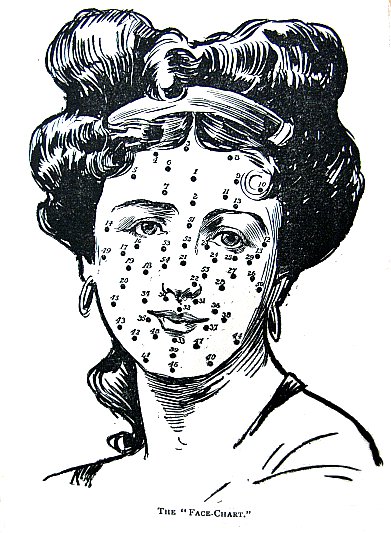
Moles, from Lilly's Book of Knowledge

From The Lilly Book of Knowledge
Written by Erra Pater, a Jewish Doctor in Astronomy and Physic,
Made English by W. Lilly, Student in Physic and Astrology.
(William Lilly lived on the 17th century, and his Book of Knowledge was reprinted - and edited, also.)

This was in the book published 1796 in Worcester

A MOLE on the forehead of a man or woman, denotes they will grow rich, and attain to great possessions, being beloved of their friends and neighbours.

A mole on the eyebrow shews a man to be incontinent, and given to the love of women; but if it be a woman, it signifies a good husband.

He or she that has a mole on the nose, signifies they love their pleasure more than any thing else.

A mole on the chin, shews the party shall never stand in need of his kin, but shall get money and grow very rich.

A mole on the neck, denotes him honorable and prudent in all his actions; but if a woman, it shews her a weak judgment, and apt to believe the worst of her husband.

A mole on a man's shoulder signifies adversity, and threatens him with an unhappy end; but a woman having a mole in the same place, shews she shall abound in honor and riches.

A man or woman having a mole on the wrist or hand denotes increase of children, but affliction in old age.

A man or woman having a mole near the heart up∣on the breast, shews them irregular, wicked, and malicious.

A mole on the belly shews the person shall be addicted to gluttony and lasciviousness.

A mole on the knee shews a man shall be fortunate in marrying, and that his wife shall be beautiful, virtuous, and very wealthy; a woman having one in the same place shews she shall be virtuous, happy, and fruitful in children.

A mole on the foot shews a man shall get riches and be happy in his children; if a woman hath the same it also betokens her the same happiness.

This was in the New York 1806 version
This was taken from The Little Gipsy Girl; OR, Universal Fortune Teller. printed in London 1799

III. Of the signification of Moles in any Part of the Body.

IF either Man or Woman shall have a Mole on the Place right against the Heart, it doth denote them undoubtedly to be wicked.

If a mole be seen on a man or woman's belly it doth demonstrate he or she shall be a great feeder or glutton.

If either man or woman shall have a mole on the bottom of the belly, it doth argue much debility, and to be often sick.

If a man shall have a mole on the knee, he shall then certainly obtain a comely and wealthy wife.

And if that woman shall have a mole on the right knee, signifieth her to be honest and virtuous; if on the left, then shall she enjoy many children.

If a man shall have a mole overthwart the nose, it doth denote that he shall wander hither and thither, through countries and cities.

A mole standing on a woman's nose doth portend that she shall travel on foot throguh sundry countries.

If a man hath a mole on the gullet or throat, it doth demonstrate that he shall become very rich.

If a woman hath a mole on the nether jaw, it doth indicate that she shall lead her life in sorrow and pain of body which shall hinder her from attaining and bearing of children: If a man shall have the form of moles on his tongue, it doth demonstrate that he shall marry with a rich and beautiful woman.

If either man or women shall have a mole on any part of the lip, it doth portend that he or she be a great feeder or glutton: and to be much beloved, and very amorous.

If a man shall have a mole on the chin, it doth argue that he shall be rich both in the substance of money and possessions.

Also a woman having a mole on the same place, it doth foretel that she shall come to the like wealth as the man, and that she hath besides the same, a like mole aloft or against the milt.

If a man shall have a mole in either of the ears, it doth argue that he shall be rich, and much reverenced and spoken of.

If a woman hath a mole in the like place, it doth denote the same good hap and fortune to her; and that besides she hath the like placed on the thigh or hams.

If either man or woman have a mole on the neck, it doth promise that they shall become very rich.

If a man shall have a mole in a manner behind the neck, it doth demonstrate that he shall be beheaded, except God (through earnest prayer) prevent the same.

If as well the man as the woman shall have a mole on the loins, it doth demonstrate a weak and poor kindred, and to be always needy.

If a man shall have a mole on the throat, it doth promise that he shall marry both with a beautiful and rich woman.

If a woman shall have a mole on the same place it doth signify that she shall also marry both with a wealthy, and very fair, or comely man.

If either in the man or woman's hand a mole appear, it doth denote prosperity, good luck, and enjoyment of children.

If either the man or woman shall have a mole on the breast, it doth threaten that he or she shall be much harmed by poverty.

A mole on the left side of the stomach, denotes a luxurious person.

A mole on the left shoulder, denotes trouble and affliction.

A mole on the left shoulder, near the arm, denotes the person given to quarrels, strife and hatred.

A mole in the middle of the stomach, denotes dangerous disease.

A mole on the right side of the forehead, promises riches and prosperity, and the like signifies a mole on the right temple.

A mole on the left corner of the eye, denotes the party subject to melancholy, and diseases that proceed thereform.

A mole on the left cheek, denotes poverty and affliction.

A mole on the lower part or tip of the right ear, threatens the party with drowning.

A mole near the bottom of the nostrils, predicts a man or woman fortunate or lucky.

A mole on the middle of the right breast, denotes the person ingenious, and given to industry.

A mole on the left side of the belly, denotes affliction and crosses.

A mole on the left buttock, threaten sickness and trouble.

A mole on hte right foot, denotes the party to be endowed with wisdom and eloquence.

A mole on the left foot, denotes rash actions whereby the party shall be endangered.

A mole on the huckle-bone, promises good fortune.

A mole on the groin, or the right side, denotes good fortune, and on the left, the contrary.

A mole on the eye-brow, signifies speedy marriage, and a good husband.

A mole on the left breast, upon the beating of the heart exactly in one place, denotes the parties, if of different sex, will come together in matrimony.

A mole on the left shoulder, denotes labor, travail and sorrow.

A mole on the right thigh, foretels riches, and advantage by marriage: on the privities it doth the like.

A mole on the right cheek, denotes a timely marriage, and such a one as shall be prosperous.

A mole on the right knee of a woman, denotes easy labor, and a loving husband.

A mole on the left buttock, denotes a pleasing person, and one very much delighted in the works of generation.

Moles on the arms and shoulders, if on the right side, portend wisdom and prudence. On the left, they signify proneness to debate and contention. But moles near the arm-holes and the regions of the breast, signify beauty, riches, benevolence and respect.

Moles on the thighs or loins of men or women, signs of want; especially being found on the left side of the body, or the left side of the thigh; let such take care of venereal misfortunes.

A mole on the upper part of the breast, on either side, especially the left, signifies a man liable to poverty.

A mole on the left side of the heart denotes wicked qualities; for persons thus marked, are rash, hasty, and head-strong in their actions.

A mole or moles on the belly of men or women denote them ravenous, and great eaters.

Moles either upon or about the knees, signify to a man riches by marriage; to a woman, if it be upon her right knee, it is a modest sign of honor, honesty and virtue; if upon the right knee it is a sign of being fruitful in children.

Moles on the ankles or feet, are held to signify modesty, and something of effeminacy in men, but courage in women.

Here's also Isidore of Seville's translation of Melampus' writing On Moles
 

Saturday, April 9, 2016

Palmestry from Lilly's Book of Knowledge

From The Lilly Book of Knowledge,
Published in New York 1806

Written by Erra Pater, a Jewish Doctor in Astronomy and Physic,
Made English by W. Lilly, Student in Physic and Astrology.

 II. Of Palmestry, shewing the various Judgments drawn from the Hand.

I SHALL next say something of Palmestry, which is a judgment made of the conditions inclinations, and fortunes of men and women, from the various lines and characters which nature has imprint∣ed in the hand, which are almost as various as the hands that have them. And to render what I shall say more plain, I will in the first place present the scheme or figure of a hand, and explain the various lines therein.

By this figure the reader will see that one of the lines, and which indeed is reckoned the principal, is called the line of life; this line incloses the thumb, separating it from the hollow of the hand. The next to it, which is called the natural line, takes its beginning from the rising of the fore finger, near the line of life, and reach∣es to the table line, and generally makes a triangle, thus △. The table line, commonly called the line of fortune, begins under the little finger, and ends near the middle finger. The girdle of Venus, which in another line so called, begins near the joint of the little finger, and ends between the fore finger and the middle finger.

The line of death is that which plainly appears in a counter line to that of life, and by some is called the sister line, ending usually at the other end; for when the line of life is ending, death comes, and it can go no farther. There are also lines in the fleshy parts as in the ball of the thumb, which is called the mount of Venus; under each of the fingers are called mounts, which are each one governed by a several planet, and the hollow of the hand is called the plain of Mars. I now proceed to give judgment of these several lines. And in the first place take notice, that in Palmestry the left hand is chiefly to be regarded; because therein the lines are most visible, and have the strictest communication with the heart and brains. Now having promised these, in the next place observe the line of life, and if it be fair, extended to its full length, and not broken with an intermixture of cross lines, it shews long life and health; and it is the same if a double line of life appears, as there sometimes does. When the Stars appear in this line, it is a significator of great losses and calamities: if on it there be the figure of two O's, or a Y, it threatens the person with blindness. If it wraps itself about the table line, then does it promise wealth and honor to be attained by prudence and industry; if the line be cut or rugged at the upper end, it denotes much sickness. If this line be cut by any line coming from the mount of Venus, it declares the person to be unfortunate in love, and business also, and threatens him with sudden death. A cross between the line of life and the table line, shews the person to be very liberal and charitable, and of a noble spirit. Let us now see the signification of the table line.

The table line, when broad, and of a lovely colour, shews a healthful constitution, and a quiet and con∣tented mind, and courageous spirit: But if it have crosses towards the little finger, it threatens the party with much affliction by sickness. If the line be double, or divided in three parts in any of the extremities, it shews the party to be of a generous temper, and of a good fortune to support it; but if this line be forked at the end, it threatens the person shall suffer by jealousies, fears, and doubts, and with the loss of riches got by deceit. If three points such as these ... are found in it, they denote the person prudent and liberal, a lover of learning, and of a good temper. If it spreads itself towards the fore and middle fingers, and ends blunt, it denotes preferment. Let us now see what is signified by

The middle Finger.] The line has in it sometimes (for there is scarce one hand in which it varies not) divers significant characters. Many small lines between this and the table line threatens the party with sickness, and also gives him hopes of recovery. A half cross branching into this line, declares the person shall have honor, riches, and good success in all his under∣takings. A half moon denotes cold and watery dis∣tempers, but a sun or star upon this line promiseth prosperity and riches. This line doubled in a woman shews she will have several husbands, but without any children by them.

The line of Venus, if it happens to be cut or divided near the fore finger, threatens ruin to the party, and that it shall befal him by means of a lascivious woman, and bad company. Two crosses upon this line, one being on the forefinger, and the other bending towards the little finger, shews the party to be weak, and inclined to modesty and virtue; and indeed, it generally denotes modesty in women; and therefore those who desire such wives, usually choose them by this standard.

The liver line, if it be strait and crossed by other lines, shews the person to be of a sound judgment, and a piercing understanding; but if it be winding crooked, and bending outward, it shews deceit and flattery, and that the person is not to be trusted. If it makes a triangle △, or a quadrangle □, it shews the person to be of a noble descent, and ambitious of honour and pro∣motion.

If it happens that this line and the middle line be∣gin near each other, it denotes a person to be weak in his judgment, but if a woman, danger by hard labor.

The plain of Mars being in the hollow of the hand, or if the line passes through it, which renders it very plain, is fortune: This plain being hollowed, and the lines be crooked and distorted, threaten the party to fall by his ill conduct. When the lines begin at the wrist, long within the plain, reaching the brawn of the hand, they shew the person to be one given to quarreling, often in broils, and of a hot and fiery spirit, by which he shall suffer much damage. If deep large crosses in the middle of the plain, it shews the party shall obtain honor by martial exploits; but if it be a woman, that she shall have several husbands, and easy labour with her children.

The line of death is fatal, when any crosses or broken lines appear in it; for they threaten the person with sickness and a short life. A clouded moon appearing therein, threatens a child bed woman with death. A bloody spot in the line, denotes a violent death. A star like a comet threatens ruin by war, and death by pestilence; but if a bright sun appear therein, it promises long life and prosperity.

As for the lines in the wrist being fair, they denote good fortune; but if crossed and broken, the contrary.

Thus much with respect to the several lines in the hand. Now as to the judgment to be made from the hand itself: If the hand be soft and long, and lean withal, it denotes the person of a good understanding, a lover of peace and honesty, discreet, serviceable, a good neighbour, and a lover of learning. He whose hands are very thick and very short, is thereby signified to be faithful, strong and laborious, and one that cannot long retain his anger. He whose hands are full of hairs, and those hairs thick; and great ones, and his fingers withal crooked, he is thereby noted to be luxurious, vain, false, of a dull understanding and disposition, and more foolish than wise. He whose hands and fingers do bend upwards, is commonly a liberal man, serviceable, a keeper of secrecy, and apt (to be poor for he is seldom fortunate) to do any man courtesy. He whose hand is stiff and will not bend at the upper joint near his finger, is always a wretched miser∣able person, covetous, obstinate, incredulous, and one that will believe nothing that contradicts his own private interest. And thus much shall suffice to be said of judgment made by Palmestry.

Saturday, April 2, 2016

Physiognomy from Lilly's Book of Knowledge

From The Lilly Book of Knowledge,
Published in New York 1806

Written by Erra Pater, a Jewish Doctor in Astronomy and Physic,
Made English by W. Lilly, Student in Physic and Astrology.

Physiognomy is an ingenious science of knowledge of nature, by which the inclinations and dispositions of every creature are understood; and because some of the members are uncompounded and entire of themselves, as the tongue, the ears, etc. and some of a mixed nature the eye, the nose and others, we therefore say, that there are many signs that agree and live together, which inform a wise man how to make his judgment, before he be too rash to deliver it to the world.
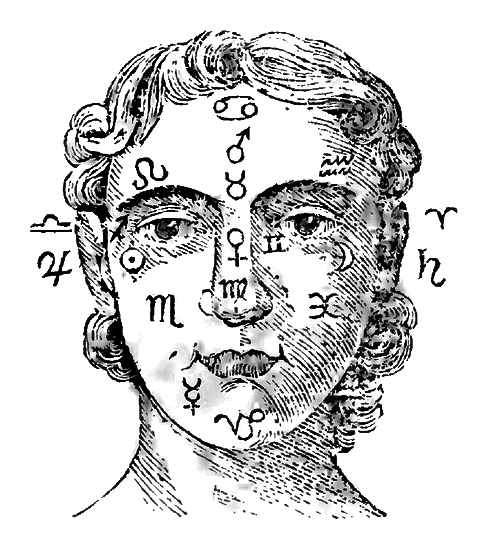
Nor is it to be esteemed a foolish or idle art, seeing it is derived from the superior bodies, for there is no part of the face of man but what is under the peculiar influence or government, not only of the seven planets, but also of the twelve signs of the zodiac, and from each governing part it is the nature and inclunation of a man or woman plainly foretold, if the person understaking this province, or pretending to it, be an artist. Which that my reader may attain to, I shall set these things in a clearer light by the following figure.

By this the reader may see at the first glance, that the forehead is governed by ♀ Mars; the right eye is under the dominion of ☉ Sol; the left eye is ruled by ☽ the Moon, or Luna; the right ear is the care of ♃ Jupiter, the left of ♄ Saturn; the ruling of the nose is claimed by ♂ Venus (which by the way is one reason that in all unlawful venereal encounters, the nose is so subject to bear the scars which are gotten in those wars) and the nimble ☿ Mercury, the significator of eloquence, claims the dominion of the mouth, and that very justly.
Thus have the seven planets divided the face among them, but not with so absolute a sway, but that the twelve signs of the Zodiac come in for a part; and therefore the sign of ♋ Cancer precides in the uppermost part of the forehead, and ♌ Leo attenting upon the right eye-brow. ♐ Sagittary does upon the right eye, and ♎ Libra upon the right ear; upon the left eye and eye-brow, you will find ♒ Aquarius and ♊ Gemini, and ♈ Aries taking care of the left ear, ♉ Taurus rules in the forehead, and ♑ Capricorn the chin, ♏ Scorpio takes upon him the protection of the nose, ♍ Virgo claims the precedence of the right cheek; and ♓ Pisces of the left; and thus the face of man is canton'd out among the signs and planets, which being carefully attented to, will sufficiently inform the artist how to pass a judgment. For according to the nature of the sign or planet ruling, so all is the judgment to be of the part ruled; which also those that have understanding know easily how to apply.

I shall now proceed to give a particular judgment of the several parts of the body: And first. Of the head.

A large head shews a person stupid and of a dull ap∣prehension, also a very small head signifies the same; but the head of a man being neither great nor small, is the prognostic of a wise man; for all extremes are irregular, and a deviation from nature; and experience has made it manifest, that a great head and small mem∣bers, do always produce much indiscretion and folly, both in man or woman; but we must also consider the several parts of the head: And first,

Of the Hair.]
The hair is only the excresence of a moist brain; yet the ancients observe several things from it; as, if the hair be thin, it shews a man to be of a weak constitution; but if curled and thick, it shews the person to be of a hot complexion: If the hair be stiff, and stand upright, either upon the head, or any other part of the body, it shews the person extreme∣ly subject to fear, and very apt to be frighted. If the hair be thick and lank, it shews the person to be meek and humble, and his constitution inclined to cold.

Of the Forehead.]
A large forehead shews a liberal man; but the forehead narrow, denotes a foolish per∣son: A long forehead shews one apt to learn, and a high forehead, swelling and round, is a sign of a crafty man, and a coward; a forehead full of wrinkles, shews a man to be envious and crafty.

Of the Eyes.]
The eyes being moist and clear, shews mirth, good manners, and an honest life, but if the eyes be declining and looking downward, or red and very great, they betoken fleshy lust; small hallow eyes signify covetousness; grey eyes an evil man, hollow eyes a crafty man, rolling eyes a wicked and vicious man, black eyes denote a sharp and piercing wit, but one lustful and incontinent; great eyes denote sloth; trembling eyes sluggishness; glittering eyes betokens drunkenness; smilling eyes shew a merry life; eyes of divers colours,, and small, denote one crafty and flat∣tering; eyes turned towards the nose, shew a man given to women; great drooping eyes, with an unsta∣ble countenance, shew a man mad; the circle of the ball green, declares a crafty wicked man, and a thief; moist eyes denote stoutness of stomach, perfect speech gluttonous and mad; high eyes, large, clear, pure and moist, are tokens of circumspection, diligent persons, and lovers; eyes always running, without sickness cause it, shew foolishness; small and hollow eyes, the cove∣tous, deceitful, and angry man; cheerful eyes betoken just men, of pleasant disposition, kind and holy; twink∣ling eyes, shew a thief and one that lays wait to catch and ensnare men; blear eyes signify a whoremas∣ter.

Of the Eyebrows.]
Upright eyebrows are amiable, but the eyebrows hanging over, shew an effeminate person. The brows very hairy, denote an impediment in his speech, and the brows being extended to the temples, shew a man to be a sloven, and uncleanly.

Of the Ears.]
Open ears shew a man to be without reason and understanding; great ears an unwise man, and small ears a fool; square ears, and of a middle size, shew a learned and wise man.

Of the Nose.]
A great nose shews a good man; a little nose a deceitful person. A sharp nose denotes an angry person, and a scold; thick and low, a person of bad manners. The nose stretching to the mouth, de∣notes honesty, strength, and aptness to learning. A nose like an ape, betokens a libidinous and riotous person; a long crooked nose, magnanimity and gener∣osity.

Of the Mouth.]
A very big mouth, with the upper lip hanging over, signifies a man foolish and unsteady, also a rash man, a babbler, a glutton, and an ungodly man. An indifferent large mouth, sheweth a bold and courageous man, a warrior.

Of the Lips.]
Thin lips with a little mouth, shews an effeminate person. Slender, thin and fine lips, be∣tokens eloquence; fleshy and great lips, a fool; and those whose teeth bear up their lips, are generally con∣tumelious, slanderers, unfaithful, also addicted to the love of women.

Of the face.]
A lean face is a token of a wise man; the face plain and flat, denotes a man of strife: The face without any rising or swelling, denotes a person injurious and unclean; a fleshy face shews a man apt to learn; a sad face sometimes denotes foolishness, and sometimes wisdom. A fat face shews a man to be a liar, and foolish; a round face signifies folly; a great face shews a man dull and slow about business; a well proportioned face shews a person to have virtuous qual∣ities, and to live a commendable life, whether they be rich or poor.

Of the Voice.]
A shrill voice denotes a person to be choleric and hasty. A great and hoarse voice shews a person to be injurious, and of a merciless temper. A weak and low voice shews a man to be fearful and cow∣ardly. A grave and slow voice shews a man to be of a sedate and quiet temper, and one of great strength.

Of the Neck.]
A neck inclining to the right side, shews a temperate man; but turning to the left side, a fool, and a man given to unlawful love. A crooked neck shews a covetous man. A thick neck denotes a rude, barbarous, ill natured man. A long slender neck shews a man to be a coward. A thick and long neck, a furious and stubborn person. A mean neck, a strong and virtuous man, and one inclined to learning.

Of the Breast.]
A broad breast is always good, and presents magnanimity, boldness, honesty and courage. A narrow breast denotes imbecility, or weakness, both of body and mind. A pursy or gross breast, shews a man to be moross, cross and void of pity. The pap• or dugs hanging down from the breast, shews a violent choleric man.

Of the Back.]
A broad back is a sign of strength; but the mean proportion of both back and breast is always commendable. A crooked or hunch back, is generally a token of a nigardly and covetous person.

Of the Belly.]
A lank belly, with a high breast, denotes a man of understanding, courage, counsel; but a great belly shews an indiscreet, foolish, proud man, and given to luxury.

Of the Arms.]
Very long arms are a sign of boldness, strength and honesty. Short arms denote a fomenter of discord and strife among friends.

Of the Hands.]
The hands very short, denote a clownish, rude, ill bread person; and if fat and fleshy, with the fingers so also, it shews they are inclined to theft. Small hands and long fingers denote a person of a genteel carriage, but crafty.

Of the Legs.]
Large and well set legs denote bold∣ness; large legs and full of sinews, shew fortitude and strength. Slender legs denote ignorance; short and fat legs cruelty. Legs crooked and hollowed inward∣ly is a sign of very ill men. Soft and swelling legs shew a man to be of very ill manners. The skin cross and short, with a sharp heel, and fat thighs, denotes madness to happen to that party.

Of the Feet.]
Small and slender feet denote hardness, but the feet full of flesh declare foolishness.

Thursday, March 10, 2016

Glitter divination


http://wiccanmoonsong.blogspot.se/2013/05/glitter-divination.html

Basically you pour glitter on a plate, play around it with your hands, eyes closed, thinking about your question. When you feel like you're done, you open your eyes and see what you have. Note the thoughts, feelings, associations, ideas, sensations and figures you see.

Thursday, February 11, 2016

Complex love divination with tally marks


You need paper, pen and a friend.
You are to start drawing lines on paper, and keep drawing until your friend says "stop!".
You need to do this four times, to have four lines of lines.

|||||||||||||||||||||||||||||||||||||||||||||||
|||||||||||||||||||||||||||||||||||||||
||||||||||||||||||||||||||||||||||||||||||||||||||||
|||||||||||||||||||||||||||||||||

If you don't have a friend, you can choose a song in random and keep drawing lines until the end of a phrase.

Now, start counting the lines. Strike out every three lines until you have 2, 1 or 0 left. Write this number down.

||| ||| ||| ||| ||| ||| ||| ||| ||| ||| ||| ||| ||| ||| ||| || = 2
||| ||| ||| ||| ||| ||| ||| ||| ||| ||| ||| ||| ||| = 0
||| ||| ||| ||| ||| ||| ||| ||| ||| ||| ||| ||| ||| ||| ||| ||| ||| | = 1
||| ||| ||| ||| ||| ||| ||| ||| ||| ||| ||| = 0

This example gives 2010

Meaning of the 4 digit result:

0000 - he feels the most tender feelings for you;
0001 - do not rush things and bother with questions;
0002 - wait for a small gift from your beloved;
0010 - he loves you;
0011 - the beloved is a very proud person, it is hard for him to admit his own feelings;
0012 - you should not be very frank with this person;
0020 - your love is truly mutual;
0021 - the guy you think about wants to meet you;
0022 - your romance can last very long;
0100 - show more concern to the young man;
0101 - he has had tender feelings toward you for a long time
0102 - it is possible to go to the cinema;
0110 - the guy is angry with you;
0111 - Unfortunately, you're just a friend, he loves another;
0120 - do not trust him, because he laughs at you;
0121 - you can open your heart to him;
0122 - a date is waiting for you;
0200 - he loves your character;
0201 - your gait fascinates him;
0202 - do not push your beloved, be more affectionate with him;
0210 - waiting for a sudden kiss;
0211 - no result, repeat the divination;
0212 - he is very fond of your name;
0220 - someone you are not thinking loves you
0221 - he does not really like your friends;
0222 - a quarrel is possible;
1000 - love relationships are unlikely, most likely, there will be a strong friendship;
1001 - visits are possible;
1002 - his thoughts are occupied by another, you are only a friend to him;
1010 - you are constantly in his thoughts;
1011 - you are waiting for hugs;
1012 - he seeks your love;
1020 - does not want anything from you, except friendship;
1021 - believes that you do not take him seriously;
1022 - you will be his wife;
1100 - strongly loves another person;
1101 - thinks of you with a smile;
1102 - wants to hug you;
1110 - wait for the long-awaited kiss;
1111 - feels indifference, the answer to feelings is not worth waiting for;
1112 - he isn't tender any more
1120 - meeting with the beloved;
1121 - is attracted to your friend;
1122 - love at first sight;
1200 - appreciates your human qualities;
1201 - can not live without thinking of you;
1202 - he likes your legs;
1210 - he likes your face;
1211 - believes that you have a very good character;
1212 - does not come for a birthday;
1220 - wants to visit;
1221 - going crazy without you;
1222 - you are too different people;
2000 - you make him sad;
2001 - feels almost no feelings;
2002 - strongly in love with another;
2010 - he's ready to admit to you his feelings
2011 - loves with all his heart;
2012 - in love without memory;
2020 - loves, but is afraid to admit;
2021 - more than once you meet;
2022 - He will write to you soon or call;
2100 - he likes your lips;
2101 - he likes your figure;
2102 - his friend will bring joyful news;
2110 - the relationship is not long-term;
2111 - feels warmly, but is now concerned about something else;
2112 - will be interested in your feelings;
2120 - He does not love you;
2121 - wants to just communicate;
2122 - you hurt him;
2200 - you like him;
2201 - very jealous of you to your friend;
2202 - do not lose your head, remain yourself;
2210 - a date;
2211 - a rupture is possible;
2212 - wants you to stay with him;
2220 - trying to cross you out of your life;
2221 - wants only to be friends;
2222 - you are often in his thoughts.

(I apologize for the choppy translation... I'm translating from Russian to English and neither is my mothertongue. But, if you don't understand something, just ask, and I'll try to explain better. :-))

Wednesday, January 20, 2016

Divination with coins


the classic head or tails
 
decide which side is yes and which is no, ask your question, focus and flip the coin.

Now, usually the number side of a coin is the tail, because most regents had their heads on the other side of the coin. In most democracies it was replaced with the coat of arms, and now there's plenty of things on the coins. 
In Russian coins, the heads is the eagle, so they sometimes call it eagles. The more eagles you get, the better. Eagles bring victory.
 
Two heads and tails

You need two coins of the same value. Focus on your question and flip the coins, one at a time.
If the first coin is tails and the second heads, your wish comes true.
Both coins are tails, your wish will come true, but it might take some time
First coin heads, second tails - you won't get what you want
Both coins heads - your wish comes true
 
Fifteen
 
You will need 15 identical coins. Preferably they have number 5 on them.
Arrange the coins in three rows of five coins. Flip the last coins on the first and last row.
two heads or tails: very lucky
first row tails, last row heads, no luck
first row heads, last row tails, maybe, but it will take time

Ink image

You need a large coin with clear image, white paper, ink and a plate. Pour some ink on the plate. Focus on the question and put the coin in the ink. Lift the coin up and place it on the paper. (You might want to do this with matchsticks to keep your fingers clean). Let it stay for a couple of hours. Now, lift the coin, carefully, perhaps with a pin, so as not to disturb the print, and look at the print.
If the print is clear, you will get your wish, quickly and easily
If the print is dark and vague, but still visible, you will get what you want, but it will take time
If the result is blurred and you can't really see what it is, you will not get your wish.

Odd handful

Take an odd number of coins, between 10 and 20 in your hand, and throw them on a surface. Count the heads and tails.
Heads = yes, tails = no

Sleep on it

Take three coins of different denominations. Take three slips of paper. Write three wishes on the papers, and wrap a coin in each, totally random. Put the packages under your pillow, and sleep. In the morning, put your hand under the pillow and take one package.
The biggest coin = "yes"
The smallest coin = "no"
The one in the middle = 50/50 chance

[Here's an interesting I Ching divination with coins and the tarot (or any oracle cards)]
 

Tuesday, October 20, 2015

Looking at the Comparative Tarot Method with One Card Comparisons

from Tarot Outside the Box by Valerie Sim
Abridged version, for educational purposes

I have to stop before going any further and make the necessary disclaimer here: There are no cards that are totally "good" and there are no cards that are inherently "bad". Some cards are generally viewed as beneficial and others are widely seen as challenging, but all of the cards can run the full spectrum between positive and negative. Until you see both the promise of the challenging cards and the pitfalls of the welcome ones, you are not a real reader. The Comparative Tarot Method can help you to discover the full spectrum inherent in each of the cards.

To illustrate, let's start with a card that most people are delighted to have appear in their readings: the Nine of Cups.

Universal Waite

I will begin with the Universal Waite version of this card, as its predecessor, the Rider-Waite deck, was my original comfort deck and is known to most Tarotists in the United States.


In this card we see the visage of the familiar chubby-cheeked and smiling older gentleman. He looks like he is very happy, good-natured, and well fed. But is he happy or is he inebriated? Sometimes he strikes me as merely jovial, while at others he seems clearly besotted.
Many people know this as the "wish card". I have heard countless beginners say it indicates that your wishes will be fulfilled and that you will get whatever you want. As a general rule, I tend to see it more as a card that indicates you will get what you THINK you want, and often as a message to "watch what you ask for; you just might get it." For the sake of this example, though, let's just consider it as indicative of a sense of satisfaction and the enjoyment of desired results. Now let's take a look at the Nine of Cups in numerous other decks to see what they might have to add utilizing the Comparative Tarot Method.

Blue Rose Tarot

The idea of the wish card is conveyed literally in Paula Gibby's Nine of Cups from the self-published Blue Rose collage deck. Here we see the famous lamp of Aladdin complete with the stroking hands and the wise genie in the background.

Ma'at Tarot


Julie Cuccia-Watts' Ma'at Tarot endows us with another version of the "wish card". Quoting Ms. Cuccia-Watts from a private e-mail, she states: "Wishes as dandelion seeds in the wind". This fits in well with the waxing Virgo Moon because Virgo in this deck denotes the barren earth of Spring. The dandelion seeds represent the symbolic power of wishes that can fill this virgin blankness. The woman in the card is literally sowing wishes on the wind. Will she like her harvest?

PoMo Tarot

Sorry about the quality of the picture, I just couldn't find a proper image of it, and I don't have it.

In the PoMo Tarot by the late artist and historian Brian Williams, this card is titled the "Nine Bottles". Edouard Manet's A Bar at the Folies-Bergère, painted in 1881-1882, inspired this card. Here our modernistic Mona Lisa looks tired, dissipated, and used up, though her eyes contain a glint of life yet unstirred. Brian Williams likened this to "the silence under the cheerful noise, the emptiness under the glitter, the loneliness of the crowd" (Williams 2003, 69). This is a snapshot of the busy social life that hides the fact that this social butterfly is one who is privately lost and floundering.
Her we have a tongue-in-cheek look at wealth, opulence, and affluence, yet we see the emptiness that may lie behind such riches. I look at this modern-day Manet and think of poor little rich girls like Barbara Hutton or disillusioned stars like Marilyn Monroe. You can have wealth, fame, riches, and so on, yet still feel empty and hollow. The dream, though achieved, is not a source of any lasting happiness.
To the simple wish card of the Universal Waite deck I would like to add with the PoMo Tarot, "Is that all there is?"

 The Servants of the Light Tarot

The next deck we will consider is The Servants of the Light Tarot, by Dolores Ashcroft-Nowicki. This deck is fairly unusual in that the Major Arcana were drawn by Josephine Gill, while the Court cards and Minor Arcana were drawn some years later by Anthony Clark. In the Nine of Cups for this deck we see a Christmas tree standing on a windowsill. The theme here is celebration adn happiness complete with presents and good cheer. From suggested visions of figgy pudding to bank notes, this card is at first glance totally positive, but reversed or ill-dignified it could mean riches or inheritance via ill-gotten gains. So is it treasure or tinsel? And who is paying for all those fantastical presents anyway?

(Christmas tree? She is talking about the Nine of Spheres, Nine of Pentacles in this deck... oops...)


The Shining Tribe Tarot
In the book accompanying The Shining Tribe Tarot, by Rachel Pollack, Ms. Pollack begins with this poem:
When the ocean fills with tears
the redeemer will come
When we have healed the ocean
we will fill it with light
Pollack 2001, 159
She goes on to relate how this card, illustrated with eight cracked jars surrounded by a central whole jar, derives from a creation myth found in the Qabalah. The eight broken pots represent the fragmented areas of our lives. The central pot is healed and shines with the dark waters of the unconscious. Ms. Pollack explains how this illustration conveys our lives of broken shards and refers to them as "pieces of truth in which the light lies buried" (Pollack 2001, 159). The card references the Orthodox Jewish belief in gilgul, or reincarnation - the idea being that it takes many lifetimes to become that central healed pot. Along the way we quest for monetary happiness, fame, and/or victories, and consequently experience a lot of broken crockery. Restoration requires helping others by sharing one's inner truth. Forgive the mixed metaphors, but this is a case where walking the talk makes the pot whole. I like this card's message about the inner spiritual health that is necessary to attain true happiness.

The Tarot of the Crone


The Tarot of the Crone is a self-published and extremely visceral glimpse of ancient wisdom by author, artist, and poet Ellen Lorenzi-Prince. Ellen's Nine has a theme somewhat similar to that of Rachel Pollack's. Again, we look at that which is broken becoming whole, but in a startlingly different and beautiful way. Ellen's poem to accompany this card she aptly subtitles "Healing" is as follows:

I am the Many and One
I am whole who has been broken
I am the power of redemption
I am the renewal of creation. 
 The Wheel of Change Tarot

Another deck that uses pots or large urns to portray the suit of Cups is Alexandra Genetti's vibrantly colorful The Wheel of Change Tarot. In the Nine of Cups in this deck we see large pots of olive oil and wine lost in a shipwreck and resting on the deep waters of the ocean (so "cuppish") while schools of fish swim among them. In almost all decks this Nine expresses some aspect of our emotions, spiritual growth and/or wholeness. This card is no exception. As Ms. Genetti writes, "the Nine of Cups represents significant growth in the understanding of our emotions and their origins" (Genetti 1997, 250). This card is an excellent visual metaphor for that concept, as it is truly necessary for us to plumb the depths of our emotions in order to experience our deepest feelings and to both understand and recover them. The depth of the sea here represents the infinite depth and breadth of the collective unconscious and the emotions and archetypes we all share. Likening back to Rachel Pollack's whole and cracked jars, depth and wholeness are an integral part of real happiness as expressed in many Rider-Waite clones with far different illustrations.

Vision Quest Tarot


The Vision Quest Tarot also uses large urns for its visual of the Nine of Cups, and this is another rendition that I really like. In this card, we see a streambed that arches gently up to a small waterfall. A young maiden is wading in the streambed filled with literally life-giving water. The stream is lined by nine large jars filled with these precious waters. This is extremely appropriate, as in almost all indigenous cultures not only happiness, but life itself, depended on the availability and quality of the potable water. The riches people and the wealthiest societies were those that harnessed and controlled their water supply. This card helps us to see that water as a symbol of emotion leads you to think of what you nourish and what nourishes you, how emotions are expressed, how they are contained, and how they are quencehd as a necessity of life. What sustains you emotionally? For what do you thirst?

The Animal Wise Tarot


In the Animal-Wise Tarot by Ted Andrews, the Nine of Cups is known as the Nine of Shapeshifters. It is illustrated with the ladybug, also known as the ladybird beetle. Ladybug is considered lucky in numerous cultures, many of which wish upon her for good luck. This small red and black beetle is an aid to pollination and dines on aphids, making it the heroine of rose gardeners and many other horticulturists. The ladybug was also said to "fly to one's true love", making it a possible messenger or herald of emotional bliss, a symbol of getting what you want, specifically as it applies to emotional needs.
The life span of the ladybug is from nine to eighteen months, so Ted Andrews cites this as the length of the lucky time span indicated by the appearance of this card. This accentuates the lucky aspects of this watery Nine and brings to mind its association with Jupiter, planet of luck, which leads us to our next deck.

Thoth


The Thoth deck, envisioned by Aleister Crowley and painted by Lady Frieda Harris, was first published in 1944 as The Book of Thoth. Though conceptualized by two concurrent members of the Golden Dawn, no two Tarot decks could be more different in look and feel than those created by A.E.Waite and Aleister Crowley.
In this card we see lotus blossoms pouring wine into nine chalices, a vision that signifies overflowing joy. Astrologically, this card corresponds to Jupiter (Happiness, trust, magnanimity, luck) in Pisces (spirituality and universal love). This combination of planet and sign suggests bliss, optimism, trust and happiness. As per the illustration, it whispers of joy/luck (Jupiter) that lets the heart (cup) overflow.

William Blake Tarot


The William Blake Tarot by Ed Buryn utilizes an entirely novel reassignment of the four suits based on the vision of artist and poet William Blake (1757-1827). The closes match to a conventional Nine of cups is the Nine of Music in the William Blake Tarot. In this deck, emotions are perceived not to be the flowing watery type of the Cups in most suits, but are described within the passionate intensity of Fire. Happiness is still the theme of this card, but it is arrived at from a slightly different direction. In his Ode on the Spring, Blake demonstrates how happiness, like the flowers of spring, are ever-renewing, but are only available to those who seek them. One is advised to passionately "kiss the joy as it flies".

(Actually, the poem is "Eternity" and it goes
He who binds to himself a joy
Does the winged life destroy
He who kisses the joy as it flies
Lives in eternity's sunrise

Thursday, October 1, 2015

Divination with Dominoes


Key Word: Innocence.
Additional meanings: Choice to be made, purity of heart, freedom, lack of restraint.
Beware tendency toward carelessness, vanity, bad judgement.

In innocence is all life reflected. It is an open book; a blank sheet of paper, awaiting the written word. It is still water awaiting the ripple of disturbance, large or small. This domino may be seen in the clear, open sky or in the unvarying, all-absorbing darkness of the night sky. Everything is possible on the blank canvas; the choice is your own.
There is the excitement of what is to come; of what may lie “just around the corner.” There are choices to be made but nothing to indicate what those choices should be. Innocence implies that there is purity of heart and, therefore, no chance of poor judgement. Yet that very innocence may translate as lack of experience, which could well lead to tragedy. Freedom is to be enjoyed but to be respected. By keeping and focusing on the purity of heart, bad decisions may be avoided.
Beware vanity. Making the right choice(s) is not the be-all and end-all for, having made a decision, it is necessary to follow-through and show your ability to handle all that results from that decision. If all goes well, then there can be a feeling of accomplishment, but that can quickly lead to self-satisfaction and arrogance. Never lose sight of the innocent phase. There is an innate joy, love, and sense of wonder connected to this tile. Don’t lose that. Keep everything in perspective 
Numerological value:0

Key Word: Success.
Additional meanings: Overindulgence, imperfections, mistakes.

This is frequently a sign of conflict and social disharmony. There is always the possibility of success and it can be within your grasp if you do not fumble, for this tile is not entirely negative. You must beware saying the wrong thing; boasting and/or claiming that which is patently untrue. There can be emotional instability here, either resulting from the above or as a result of it. There is a feeling of being on the outside looking in, with a burning desire to reverse the situation and to be a part of what is going on. There is a desire for respect and yet an inability to command it. Too aggressive behavior can defeat what you unconsciously desire.
You may feel that you have reached an impasse; that you have gone too far and it is now impossible to reverse things. But you can make use of this stalemate. Take the time to search within yourself and to find that sincerity that lies deep within. If you present it gradually – without flinging it in the face of those with whom you are in conflict – than your sincerity can bring about a turn of fortune. It can bring about the eventual success that you desire.
We all make mistakes. But the wiser person learns from his or her mistakes. When things seem to go wrong, examine the course of events and see if there wasn’t some other way you might have handled things, and remember that for next time. Success is always within your grasp – you just need to focus on it then reach out and grasp it.
Numerological value: 1


Key Word: Family.
Additional meanings:Home, contentment, perfect love, attainment, bliss ... but tread cautiously.

This is a tile of blessing. It frequently ties-in with family love and harmony. There is success, if not financially at the very least in relationships. Abundance in all things is often indicated.
This tile is a bright omen of what lies ahead, reinforcing what has already been achieved. Many times the appearance of this tile indicates an approaching initiation, in the sense of a new beginning. It might be a new job, it might be relocation, it might be a marriage or business partnership. It signals attainment. You have accomplished more than you ever thought you would or could. There is, however, a caveat: a word of caution. Do not rest on your laurels. Do not think that because you have attained a particular level, there is no need to continue the climb. Always look ahead. “Onward and upward” apply here. This is tile of the optimist, not the pessimist.
There is abundance of life reflected here. Procreation, eroticism, pleasure, even birth are in this tile. It is the realization of a dream and the attainment of goals. There are indications of swelling bank accounts; of growing circles of friends; of new interests and horizons. All are within easy reach. They do not have to be accepted, but they are available. Remember always not to stagnate.
Numerological value: 2


Key Word: Birth.
Additional meanings: Birth of idea, news, new proposal. Trust.
Beware tendency toward deception, seduction.

You possess the energy that is found in new birth, in the blossoming of springtime, the flowers bursting forth in a grand array of colors. A new cycle of birth/rebirth and fresh beginnings is here. There is also healing and intuition. As a child enters the world, it must trust in all that has brought it forth, for it takes time to achieve and accept self-responsibility. Only over time will strength develop and new pathways be made. The focus here is on the early steps. There is news of birth; of new life.
You are pointed toward a new way of progress. You will need to prove yourself. You will need to test your strength and fine-tune your judgements. It is said that from small acorns grow mighty oaks. Let this be your inspiration. Know that you have great potential and that for you all things are possible.
A motherly influence can be felt, with this tile. There is gentle nourishment with positive encouragement. Purification may be needed to ensure adherence to the right path. Look for news about an opportunity, proposal, or early investment. This is also a tile that works with feminine energies and with healing powers. To carry this tile, close to the heart, can produce great recuperative energy. It will promote personal well-being, physically and mentally.
Numerological value: 3

Saturday, February 28, 2015

A really great blog entry about cartomancy!

Mastering Modern Cartomancy
Posted on January 28, 2015 by Cardseer


Do follow the link and read the article, I'm just posting a short referate for my own use.


- the numbers have significance as well as the suits
- it can be intimidating to use the intuition without key words and pictures, with only the suit symbols and numbers, but you will learn
- It's easier to learn the meaning of cards and card combinations if one practices regularly with a few cards. Tarot cards are easier to learn through "card of the day" practice, but playing card combinations have significance, and thus it's better to do a simple three card spread.

 
One way of reading these cards is "past, present and future".
Now these are mainly for tarot cards, but there is really not that much a difference.
And just to bore you to tears, here's some more suggestions
(Or perhaps the same... that 25 ways was pretty exhaustive. :-D)
But - you get the idea.
This is how to build spreads.
You decide how many cards, which symbol, which questions, 
what is the meaning of different positions, etc. 
This is how the different traditional spreads were born. 
You are just as good and effective to create spreads as those who created the classic ones...
The difference is only that the existing ones you don't need to think...

- draw three cards every morning, thinking about the day. Analyze the cards, read different meanings, think about the combinations. Note your overall intuitive impressions.
- record your interpretation in a cartomancy journal, including "significant influences"

Do not be discouraged. There is an easy way I’ve found to master the playing cards through regular practice by analyzing the simple three-card spread. I advise drawing three cards every morning for insight into the coming day. Analyze the cards for all the possible meanings that come to mind. Contemplate the cards individually and in combination. Suit interactions and overall intuitive impressions should also be noted. Get a feel for what the cards mean before referring to a book or your notes. Record the resulting interpretations in a cartomancy journal including significant internal and external influences such as time of day, weather, moon phase, moon sign, mood, etc.

You will discover that mood can have an effect on the cards you draw. You may find that your readings are clearer during certain times of the moon phase or when the moon is in a particular zodiac sign. You might be surprised by how often the weather will appear in your daily cards.

Shuffle the cards while you focus on your question. I like to ask, “What will I experience today?” If you prefer a more structured reading, you can decide ahead of time to apply special significance to each card position, such as “morning, noon, night” or “past, present future” or “premise, situation, outcome.” I prefer to keep the reading fluid and allow the cards to speak to me freely.

Then at the end of the day examine your cards to determine how they reflect the energies of your day, and which of your predictions prove accurate. When something occurs in your day that was clearly predicted in the cards, but you missed seeing that morning, consider it a valuable learning experience. The next time this card combination appears, you will automatically remember the new interpretation.

If you find that you are unable to relate the events of your day to the cards, keep referring back to the reading over the coming week. Sometimes the predictions in a cartomancy daily draw can take up to a week to manifest in your life. Meditate on the particularly challenging combinations. Your Higher Self is fluent in the language of the cards.

As you continue this practice, you will easily assimilate the card meanings, and the subtle ways the cards interact in a spread. The experience you gain will enable to you tackle larger card spreads with ease. In time this daily practice will help you build new card associations. You will move beyond the meanings you learned in a book, and begin to develop your own personal meanings for the cards.

Monday, February 23, 2015

Cartomancy II


 When using cards to divide the unseen and unknowable, one starts by giving each card a symbolic meaning. These meanings differ from country to country and time to time, so you can choose which ever meaning that fits you best. After all, divination is reading the symbols. The cards themselves have no magical, mystical powers. :-D

But - that being said - there are beliefs associated with reading the cards.

There are the spreads, that are about the same as with tarot cards.

The card combinations have a meaning as well as individual cards and their placement.

Serena Powers says this:

Interpretations from Shuffling and Cutting

Who would have thought that a reading can begin from the cards even before that first card is laid out. Look carefully and note how the cards are shuffled and cut. Every person is different and has their own style, but this can even differ between readings.

When a person shuffles only the bare minimum number of times, this of course shows how eager they are to get straight to the point.

 When cards one or a few cards fall out during shuffling, take note of what they are because they are important to the reading.

When a lot of cards fall out, the querent is either not used shuffling cards, or they are reluctant or ambivalent about the reading.

When a person cuts only the top few cards from the deck, or leaves a tiny little pile, then they are reluctant to do the reading. This shows they do not really want to reveal too much or find out the true answer.

When cards fall from the deck as a person cuts the cards, this also shows a certain ambivalence or reluctance about the reading.

Shy and impressionable people cut the deck with their face virtually inches from the cards. They also tend to take any interpretations extremely literally despite their avowed scepticism.

Troubled querents also cut the deck with their faces inches from the deck and may take some time to do it. I also find these people tend to cut the deck dead centre if they can manage it and are most concerned to be doing it "right". These people tend to demand exact predictions and interpretations but this is because they are so troubled by their question.

Complex people tend to cut into multiple piles. These people cannot decide if they want to take the cards seriously or not.

Querents who are confident of the answer they think they will receive cut with their arm fully extended, often with a smile on their face.

There are people who barely glance at the cards when cutting them and expect you to shuffle and replace the cards in one pile. These people do not expect anything from the cards and are majorly sceptical or simply do not really want a reading.

When querents sit right back in their chairs and cross their arms you know they are feeling defensive. When the cards get right to the heart of the issue, you notice them lean forward and the arms are uncrossed. This simple body language reveals so much, and can be useful when the querent is determined to say only the bare minimum.

The next time you do a reading for yourself, notice how you cut the cards. Often you can pick up from the cut if you are secretly reluctant to know the answer (usually because your intuition/subconscious already knows the answer won't be what you want to hear).

Special Combinations to be aware of

    Ace of hearts next to any other heart – Friendship
    Ace of hearts with another heart on each side – Love affair
    Ace of hearts with a diamond on each side – Money
    Ace of hearts with a spade on each side – Quarrels
    Ace of diamonds with the eight of clubs – Business proposal
    Ace of spades with the king of clubs – A politician
    Ace of spades with the ten of spades – A serious undertaking
    Ace of spades with the four of hearts – A new baby
    Ten of hearts – Cancels adjacent cards of ill fortune; reinforces adjacent cards of good fortune.
    Ten of diamonds with the two of hearts – Marriage bringing money
    Ten of spades – – Cancels adjacent cards of good fortune; reinforces adjacent cards of ill fortune.
    Ten of spades next to any club – Business troubles
    Ten of spades with a club on each side – Theft, forgery, grave business losses
    Nine of hearts with the five of spades – Loss of status
    Nine of clubs with the eight of hearts – Gaiety
    Nine of diamonds next to any court card – Lack of success, an inability to concentrate
    Nine of diamonds with the eight of spades – A bitter quarrel
    Nine of spades with the seven of diamonds – Loss of money
    Eight of hearts with the eight of diamonds – A trousseau
    Eight of hearts with the five of hearts – A present of jewelry
    Eight of spades on the immediate right of the client card – Abandon your current plans
    Four of hearts next to any court card – A loss, injustice
    Two of clubs with the two of diamonds – An unexpected message

Cartomancy


Cartomancy is fortune-telling or divination using a deck of cards. Forms of cartomancy appeared soon after playing cards were first introduced into Europe in the 14th century. Practitioners of cartomancy are generally known as cartomancers, card readers, or simply readers.

Cartomancy is one of the oldest of the more common forms of fortune-telling. It is similar to tarot card reading in that various card spreads are used, such as single card, "Destiny Square," and 3 cards. The tarot is actually a form of cartomancy, as is oracle decks and other divination forms using cards.

Cartomancy using standard playing cards was the most popular form of providing fortune-telling card readings in the 18th, 19th and 20th centuries.
In English-speaking countries, a standard deck of Anglo-American bridge/poker playing cards (i.e., 52-card, four-suit set) can be used in the cartomancy reading; the deck is often augmented with jokers, and even with the blank card found in many packaged decks.
In France, the 32-card piquet playing-card deck was, and still is, most typically used in cartomancy readings, while the 52-card deck was, and still is, also used for this purpose. (A piquet deck can be a 52-card deck with all of the 2s through the 6s removed. This leaves all of the 7s through the 10s, the face cards, and the aces.)

Harry Roseland; Reading the Cards, 1899

 
 Cartomancy by an unknown artist... looks Russian to me.

Playing cards were invented in China. There are cards as old as from the 9th century and it was in teh 9th century a writer referenced to playing cards, calling them "the leaf game". It is probably associated with the development of books, from rolls to sheets of pages.
The Chinese cards have four suits - coins; strings of coins (which may have been misinterpreted as sticks from the crude drawing); myriads of strings of coins and tens of myriads...

Here two of these cards; 1 of strings and 3 of coins. The myriads were usually depicted as people.

By the 11th century, playing cards were spread throughout the Asian continent and later came into Mamluk Egypt.[9]:309 The Mamluk pack contained 52 cards comprising four suits: polo sticks, coins, swords, and cups. Each suit contained ten spot or pip cards (cards identified by the number of suit symbols or "pips" they show) and three court cards, called malik (king), nā'ib malik (viceroy or deputy king), and thānī nā'ib (second or under-deputy). The thānī nā'ib is a non-existent title so it may not have been in the earliest versions. The Mamluk court cards showed abstract designs or calligraphy not depicting persons (at least not in any surviving specimens), though they did bear the names of military officers. Nā'ib would be corrupted into naibi (Italian) and naipes (Spanish), the latter still in common usage. The pip cards in two suits had a reverse ranking, a feature found in many old European card games.

mamluk cards - highly ornamented, no depiction of people.

Playing cards first entered Southern Europe in the 14th century, probably from Mamluk Egypt, using the Mamluk suits of cups, coins, swords, and polo-sticks, and which are still used in traditional Latin decks. As polo was an obscure sport to Europeans then, the polo-sticks became batons or cudgels.

Playing card symbols
The German symbols of acorns and leaves should be reversed 

- swords, leaves, piques, spades and batons, acorns, trèlles and clubs/clover

As cards spread from Italy to Germanic countries, the Latin suits evolved into the suits of Leaves (or Shields), Hearts (or Roses), Bells, and Acorns, and a combination of Latin and Germanic suit pictures and names resulted in the French suits of trèfles (clovers), carreaux (tiles), cœurs (hearts), and piques (pikes) around 1480. The trèfle (clover) was probably derived from the acorn and the pique (pike) from the leaf of the German suits. The names "pique" and "spade", however, may have derived from the sword of the Italian suits. In England, the French suits were eventually used, although the earliest packs circulating may have had the Italian suits. This may account to why the English called the clovers "clubs" and the pikes "spades".

"Coeurs, Hearts - denotes the Church.
Carreaux, Diamonds - denotes the arrowheads which are symbolic of the vassels from whom the archers were drawn.
Trefles or Clover, Clubs - signifies the husbandmen.
Piques, Spades - denotes the the points of Lances, symbols for the knights themselves."
- History of playing cards

 As you see the coins in the Chinese cards, they have a clear diamond figure in the middle.

When using cards to divide, one may choose to use the joker(s) and/or empty cards and give them a meaning. The Joker usually is interpreted as the Fool of the tarot deck, even though it has a different background story.

In the 19th century, people were playing the game of Euchre [from German Juckerspiel, (Jucker is a carriage horse, which is why I believe the game was called Junkerspiel. Junker is a young nobleman.)]. This Juckerspiel most likely developed from Karnöffel, a game where the jack is the "best" card. In USA the name of the game was Juker (originally pronounced as ewe-ker, not as jew-ker), and they added an extra jack, the best jack, unsuited, called Juker and later Joker. It was because of this, the depictions melted together with the tarot Fool.

Experimenting :-)

 Divination is more about what happens inside your head than the tools. Anything can be used as an oracle, symbol, message, sign. So, I deci...